
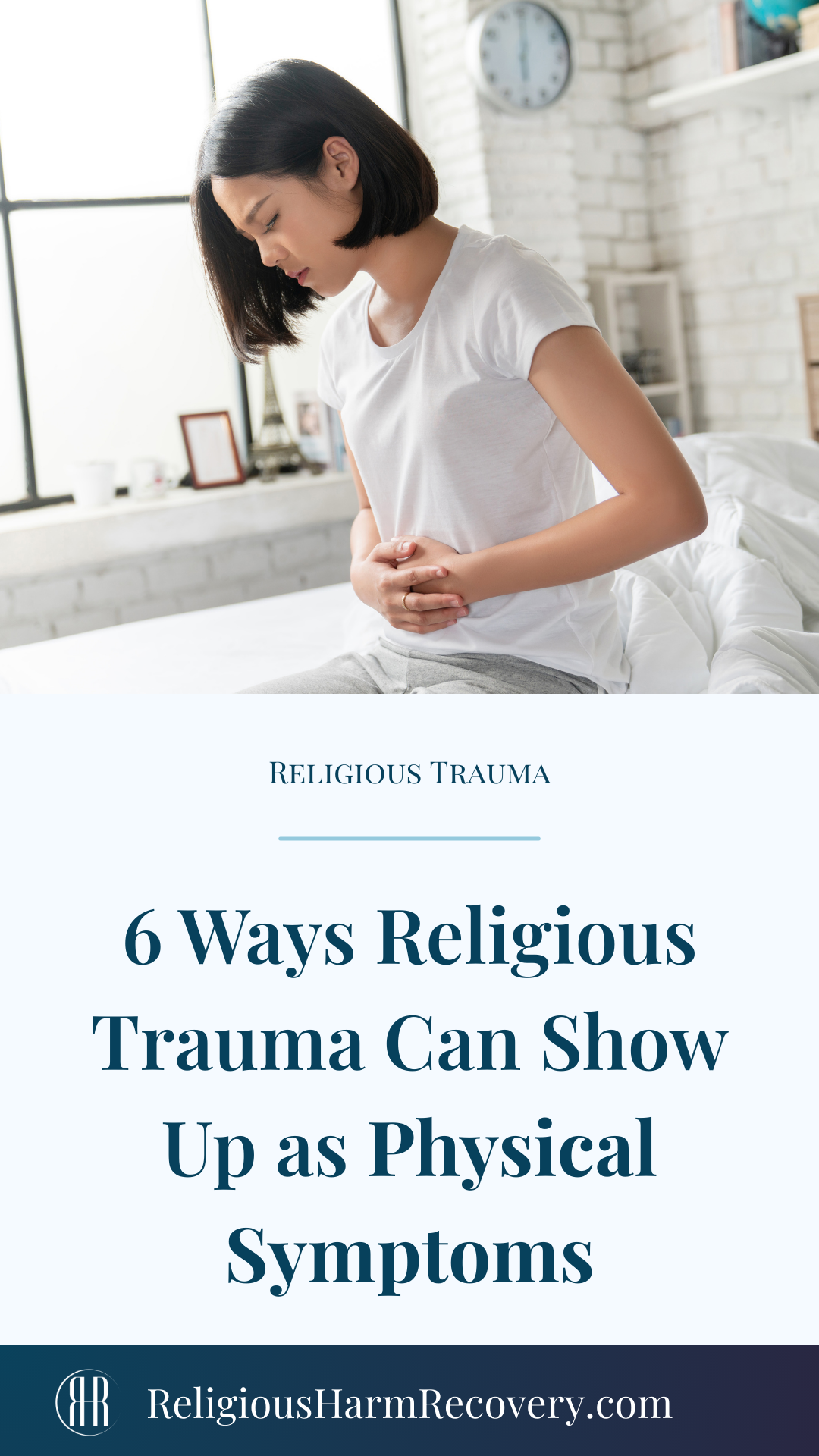
6 Ways Religious Trauma Can Manifest in Physical Symptoms
In recent years, we’ve started to really understand the toll that indoctrination into high control religions can take on us, and the term religious trauma continues to become more well-known and widely accepted as an area of concern in the mental health health community.
Recent research has also begun to systematically document religious and spiritual abuse as a form of trauma with measurable impacts on mental health and well-being.[1]
However, what’s important to understand is that religious trauma is not just about emotional or psychological distress—it can also affect us physically.
In this article, we’re going to cover seven of the most common physical symptoms of religious trauma.
From feeling disconnected from your body to experiencing unexplainable pain, these symptoms are your body’s way of signaling the deep impact religious harm has had on your nervous system.
And as someone who’s navigated this path personally, I know how tough it can be to deal with not only the emotional and psychological fallout from religious indoctrination, but the physical fallout as well.
What We’ll Be Covering:
Before we dive into the physical symptoms of religious trauma, let’s first define what it is and how it can manifest in our lives.
Religious trauma refers to the long-lasting emotional, psychological, and social damage caused by harmful religious teachings, or experiences.
It can affect folks who have been part of a high control religion or cult, but it can also affect those who have experienced spiritual abuse in more mainstream religious groups.
Religious trauma is best understood through the lens of trauma in general, which involves experiencing deeply distressing or disturbing events that overwhelm your ability to cope.
In the context of involvement in a high-control religion, religious trauma specifically refers to the psychological and emotional distress resulting from:
- manipulation
- coercion
- emotional or physical abuse
- consequences from rigidly enforced rules
- indoctrination practices
- and the imposition of unrealistic standards and expectations
Any of these experiences can negatively impact your sense of self-worth, identity, and well-being, which is considered religious trauma.
Religious trauma can lead to symptoms such as anxiety, depression, guilt, shame, fear, and a loss of trust in oneself or others and often persists long after leaving the high-control religious group.[1]
But another key characteristic of religious trauma is the way it often manifests as physical health problems, which we’ll be specifically focusing on in the remainder of this article.
What is the Connection Between Religious Trauma & the Body?
The interplay between religious trauma and the physical body is both simple and complex.
As we take a closer look at this connection, it’s important to understand the role of the nervous system through both hyperarousal states and hypoarousal states.
Both of these states are natural defense mechanisms designed to shield us from harm.
However, when these responses are activated by religious stressors, our physical health and well-being can be negatively affected.
Let’s start to unpack why this is and how it might look.
The Role of the Nervous System
High control religions (a.k.a. religious cults) routinely use tactics such as fear, guilt and shame to coerce and control their followers.
These experiences stress your body’s nervous system, putting it into one of two states—hyper-arousal or hypo-arousal.
Here are a few more details about each.
Over time, involvement in high control groups can lead to chronic dysregulation in your nervous system.
The Connection Between the Nervous System & Physical Symptoms
The nervous system is responsible for operating all of our bodily functions that run on autopilot, such as breathing, digestion, etc.
When it becomes activated in response to perceived danger or threat, it enters a state of either hyper-arousal or hypo-arousal.
Hyper-arousal
When the body’s nervous system becomes hyper-aroused, it can trigger a range of physical responses to prepare for either fighting the threat or fleeing from it.
One notable example is an accelerated heart rate, which occurs as the body attempts to pump more blood to the muscles, ensuring they receive the oxygen required for rapid action.
Additionally, increased breathing rate is another common response, aimed at taking in more oxygen for heightened alertness and physical readiness.
In general, here are some of the most common physical symptoms associated with hyper-arousal:
Hypo-arousal
When the body’s nervous system becomes hypo-aroused, you find yourself unable to move or act.
Hypo-arousal may manifest physically as a sudden drop in heart rate and a significant decrease in blood pressure, leading to feelings of faintness, dizziness or even numbing in your extremities.
In this state, you may also experience a sense of detachment from your surroundings, as if you’re a bystander in your own body (dissociation).
This hypo-arousal is the body’s way of conserving energy and protecting itself from perceived harm when escape or confrontation is not an option.
In general, here are some of the most common physical symptoms associated with hypo-arousal:
Your Body’s Innate Survival Mechanism
It’s important to understand that your nervous system is protecting you.
The nervous system’s responses to either real or perceived threat are its attempts at giving you the best possible chance of survival.
So if you’ve identified yourself in either of the above nervous system response patterns, please be gentle with yourself.
Having that type of response is NOT a sign of weakness or fragility on your part.
It’s simply a sign that you were in a deeply unsafe environment and your body was responding accordingly.
However, these responses, while beneficial in immediate danger, can become detrimental when persistently activated, such as during ongoing stress from involvement in high control religion.
What are the Most Common Physical Symptoms of Religious Trauma?
Next let’s take a look at some of the most common physical symptoms of religious trauma.
As we review these, keep in mind that each symptom is a manifestation of the body’s response to the stress and dysregulation caused by the incredible stress of being indoctrinated into a high control religion.
Essentially, each of the physical symptoms below are what can occur when your body is stuck in a state of either chronic hyper-arousal or chronic hypo-arousal.
Remember, these responses are natural and understandable reactions to deeply distressing experiences.
Understanding how physical symptoms show up as a response to religious trauma is a step toward healing, allowing for recognition and validation of what you’ve been through.
1. Dissociation
When we dissociate, we disconnect from our thoughts, feelings, memories, and even our sense of self.
This can manifest as a feeling of being outside of one’s body, losing track of time, or feeling emotionally detached.
Physically this may be experienced as numbness, tingling, dizziness, or faintness.
Generally speaking, dissociation is a hypoarousal state and occurs when your nervous systems does not believe fight or flight is an option.
2. Digestive Issues
Stress and trauma can have a significant impact on our digestive system.
It is not uncommon for those who have experienced religious trauma to develop gastrointestinal issues such as irritable bowel syndrome (IBS), acid reflux, or ulcers.
Furthermore, the constant state of anxiety and fear associated with high control religions can wreak havoc on the body’s ability to properly digest and absorb nutrients.
I’ve also discovered in my work with religious trauma survivors that chronic constipation seems to be quite common as well.
This is likely due to the involuntary tightening of the pelvic floor muscles as the body prepares to “face-off” with a perceived threat.
The various digestive issues listed above may be connected to both hyperarousal and hypoarousal.
3. Sexual Performance Difficulties
Shame, guilt, and fear around sexual thoughts or behaviors are common amongst folks indoctrinated into high control religions.
This can lead to difficulties with intimacy, low libido, or even sexual dysfunctions such as erectile dysfunction or vaginismus.
Furthermore, the restrictive teachings and practices of certain religions often create a sense of disconnection from one’s own body and desires, making it difficult to experience sexual pleasure.
If this sounds like you, I’ve written a couple articles on the topic of purity culture you may find helpful:
4. Hypervigilance
Constant vigilance, anxiety and feeling “on edge” are all common physical symptoms experienced by survivors of religious trauma.
This is because the fear-based teachings and strict rules of high control religions can lead to a constant state of stress and hyper-awareness.
This can manifest physically as muscle tension, increased heart rate, fatigue, sweating and/or nausea as well as mental health issues like generalized anxiety disorder or panic attacks.
These are all symptoms of a hyperaroused nervous system.

5. Sleep Disturbances
When you’ve been subjected to religious indoctrination, your nervous system can remain in a heightened state of arousal, which interferes with the body’s natural ability to relax and enter the restful phases of sleep.
This is because the mind remains vigilant, which can lead to insomnia, nightmares, or restless sleep.
Consequently, the lack of quality sleep often exacerbates other symptoms of religious trauma, creating a vicious cycle of stress and sleeplessness.
6. Chronic Pain
Emotional distress, such as that experienced from religious trauma, can significantly contribute to the development of chronic physical pain.
This occurs as the body’s stress response is continuously activated, leading to inflammation and changes in the way the brain processes pain signals.
Conditions like chronic pain, while appearing purely physical, may have roots deeply embedded in psychological trauma.
Usually this is a symptom of nervous system hyperarousal.
What’s the Best Approach for Treating Physical Symptoms of Religious Trauma?
When trauma is stored in the body, the best treatment approach will generally be a body-based approach, such as some form of somatic therapy.
Somatic therapy is considered a “bottom up” approach to healing trauma.
This means that it focuses on releasing and working through the trauma at a nervous system level rather the simply talking about it or trying to cognitively process the experience.
There is a role for cognitive processing as well, but traditional talk therapy typically doesn’t create the conditions for the nervous system to release trauma or develop a more regulated baseline.
Examples of somatic therapy include Somatic Experiencing, EMDR (Eye Movement Desensitization and Reprocessing), and Brainspotting.
I incorporate each of the modalities into my one-on-one sessions with clients. You can find out more about my approach HERE.
The reason I often discuss somatic experiencing in my content and frequently incorporate it into my clinical work is because a 2021 literature review of Somatic Experiencing found preliminary evidence that this body-based modality can reduce PTSD-related symptoms as well as affective and somatic complaints, suggesting that working directly with the body can support both emotional and physical aspects of trauma recovery.[2]
In addition to somatic therapy, other forms of self-care such as mindfulness, yoga, and proper nutrition can also play a significant role in managing physical symptoms of religious trauma.
References
- Ellis, H. M., Hook, J. N., & Zuniga, S. (2021). Religious/spiritual abuse and trauma: A systematic review of the empirical literature. Journal article, APA PsycArticles.
- Kuhfuß, M., Maldei, T., Hetmanek, A., & Baumann, N. (2021). Somatic experiencing – effectiveness and key factors of a body-oriented trauma therapy: A scoping literature review. European Journal of Psychotraumatology. Open-access article.
Some Possible Next Steps:
If this article resonated with you and you’re wondering where to go from here, you might consider the following options:
Related Articles
-
How Religious Trauma Affects Your Nervous System
This article explains how the nervous system responds to religious trauma—fight, flight, freeze, and fawn—why freeze and fawn are often the most common. It also includes how these trauma responses may still be showing up today.
-
How to Tell if You Have High-Functioning Religious Trauma
On the surface, high-functioning religious trauma looks makes it appear as though you “have it all together” while under the surface, this high-functioning persona is being fueled by fear, anxiety, and stress.
-
Religious Trauma Bonds: What They Are & How They Develop
In this article, I’m talking about something I see all the time in my religious harm recovery work: trauma bonds. While this term is often used when discussing abusive relationships, trauma bonds can also form in authoritarian religious groups where…