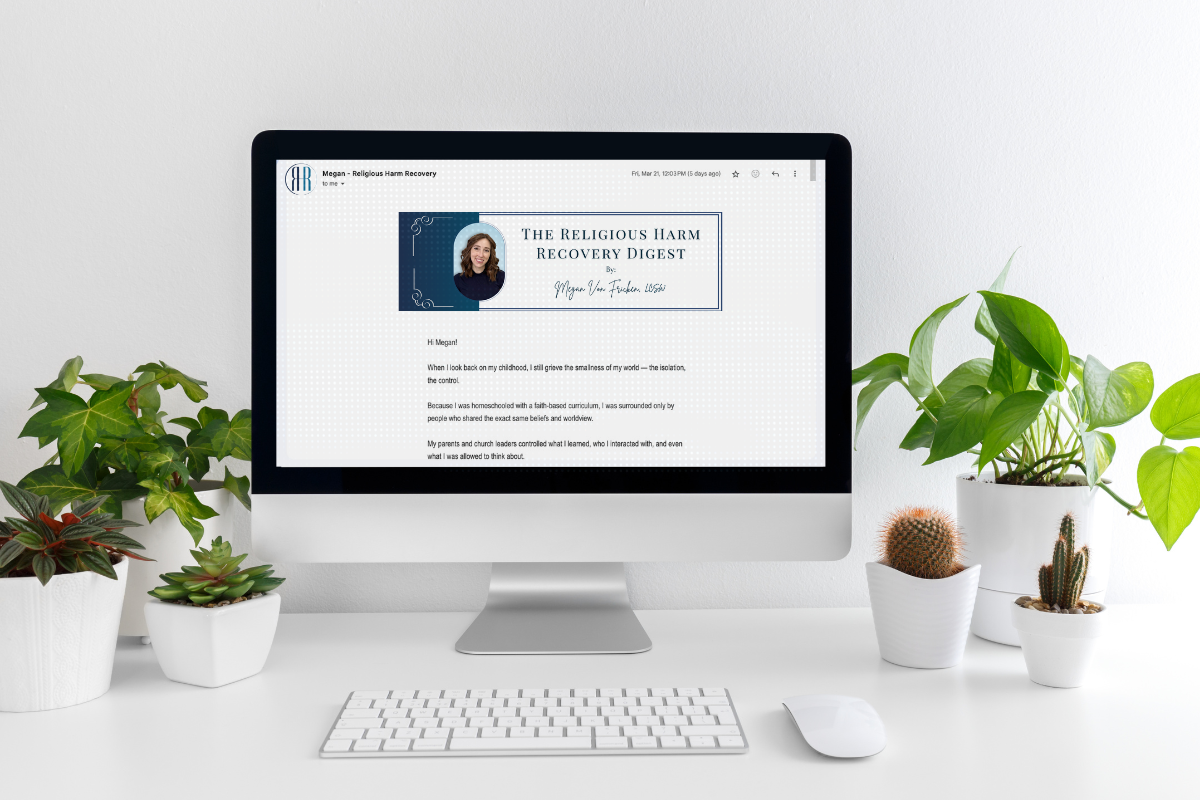
The Newsletter Archive
Includes:The Religious Harm Recovery Digest & A Note from Megan
The RHR Digest & A Note From Megan are subscriber-funded publications.
(Currently closed to new subscribers.)
Looking for something specific?
-
The fallout from forced vulnerability
The Religious Harm Recovery Digest | Many high-control religions encourage a version of rapid intimacy built on emotional disclosure, vulnerability, and spiritual performance. This piece examines how those dynamics can continue affecting relationships after leaving, along with practical ways to build trust and connection at a healthier pace.
-
Hooked by forced vulnerability — the faux bond of intimacy manufactured by high-control religion
A Note From Megan | Many high-control religious spaces encourage a kind of forced vulnerability that can feel deeply intimate at the time. In this Note, I reflect on how those dynamics affected my understanding of closeness, emotional safety, and connection long after leaving religion.
-
Are you “too nice?” — compulsive niceness as a trauma response
The Religious Harm Recovery Digest | What if being “too nice” is not simply a personality trait, but a survival strategy? This Digest explores fawning as a religious trauma response and why boundaries alone often fail to resolve the deeper nervous system dynamics underneath compulsive appeasement.
-
Modesty culture & “the male gaze”
A Note From Megan | This Note explores the connection between “modesty culture” found in many high-control religions and “the male gaze,” which upholds patriarchal beauty standards both inside and outside of religion.
-
Navigating relationships with indoctrinated loved ones
The Religious Harm Recovery Digest | Maintaining relationships with indoctrinated loved ones can create an enormous amount of mental and emotional load, especially when you’re no longer operating from the same version of reality. This Digest discusses how to recognize the mental and emotional load in your relationships, identify safer areas of connection, and establish boundaries that protect your relationship with yourself.
-
Always striving, never arriving–reflections on the Protestant work ethic
A Note From Megan | Living in a culture shaped by the Protestant work ethic can leave many of us feeling like we’re always striving and never arriving. In this Note, I share how this has shown up in my own life and why this cultural phenomenon often creates more complexity for folks recovering from religious trauma.
-
Your childhood autonomy was intentionally erased
The Religious Harm Recovery Digest | In childhood, autonomy develops when you get to notice your own internal signals, make age-appropriate choices, and discover you can survive being a separate person. This Digest looks at the nine ways high-control religion intentionally interrupts that process.
-
🗝️ Unlocked Newsletter | Making sacrifices in pursuit of “God’s calling”
A Note From Megan | For many of us, high-control religion required more than belief. It asked us to sacrifice our dreams, our interests, and our aspirations. In this note, I share a piece of my own reclaiming process as I return to something I once gave up in pursuit of “God’s calling.”
-
Hijacking your reality–the root of what keeps you compliant
The Religious Harm Recovery Digest | After leaving high-control religion, it can be startling to look back on beliefs that once felt like absolute truth. This Digest explores how groups distort reality to keep people compliant, and what it can look like to find your way back to a more grounded sense of reality once you’re out.
-
Do you still gaslight yourself? How self-gaslighting operates as a survival strategy
The Religious Harm Recovery Digest | Leaving a high-control religion doesn’t always mean you stop questioning your own reality. This RHR Digest breaks down self-gaslighting, how it forms, what it can look like in daily life, and how to start rebuilding self-trust.
-
Re-evaluating your purity culture marriage: Does it still feel like the right fit?
The Religious Harm Recovery Digest | If you’re re-evaluating a purity culture marriage after deconstruction, this Digest will walk you through areas that may change over time, what to notice in yourself and the relationship, and how to think about possible next steps.
-
Why it’s hard to “feel your feelings”: A sneaky way spiritual bypassing can still show up
A Note From Megan | If you’ve ever wondered why it still feels hard to “feel your feelings” after leaving a high-control religion, this might resonate. In this Note, I talk about “non”-spiritual bypassing and the ways we continue avoiding difficult emotions without even realizing it.
-
Scared Into Submission: How growing up in fear affects childhood development
The Religious Harm Recovery Digest | When you’re exposed to chronic, fear-based messages throughout childhood, it can influence how you learn to feel safe, connect to other people, and make sense of who you are. In this Digest, we’ll look at 6 areas of childhood development that are often negatively impacted by a high-control religious upbringing.
-
🗝️ Unlocked ANFM | I wish my grandmother had chosen feminism
A Note From Megan | In this Note, I reflect on my grandmother’s choices and the divergent paths women faced during the rise of feminism and the religious right. As I watch Mrs. America, I can’t help but wonder how different our lives might have been if she had chosen liberation instead of control.
-
Religious trauma can show up as hyper-competence
The Religious Harm Recovery Digest | Hyper-competence might look like a strength, but it can also be a trauma response. In this digest, I take a closer look at how high-control religion wires you for over-performance and how to start releasing the internal pressure that often comes with it.
-
Can men & women be “just friends?”
A Note From Megan | In this Note, I explore the complex question of whether men and women can truly be “just friends,” challenging traditional beliefs that are influenced by both purity culture and pop culture. I also share my evolving perspective on ways attraction, friendship, and connection can exist outside the gender binary.
-
Purity culture & “sexual dysfunction”
The Religious Harm Recovery Digest | Many people leave purity culture feeling disconnected from their bodies, but what’s often labeled “sexual dysfunction” may actually be your nervous system doing exactly what it learned to do in a high-control system. This Digest offers a more clinically-sound way to understand what’s happening in your body.
-
Thinking about anger a little differently
A Note From Megan | Anger is often seen as a negative emotion, but what if we viewed it as a source of wisdom and empowerment? In this Note, I share insights on how embracing anger can guide us toward change and healing, especially for those navigating the complexities of leaving a high-control religion.
-
Christianity’s freaky martyr fetish
The Religious Harm Recovery Digest | This Digest focuses on Christianity’s martyr obsession and how it’s used as tool of coercive control to more deeply indoctrinate people into a specific system of beliefs. It also covers the lingering impact even after leaving a high-control religion.
-
Can conflict be an act of love?
A Note From Megan | If conflict still feels risky for you, there’s usually a reason. Many of us grew up learning that the safest thing to do was to avoid it altogether. In this Note, I share why avoiding conflict keeps relationships stuck at a surface level and how engaging in conflict with safe people can open the door to deeper, more honest connection.
-
“Spiritual, not religious.”
The Religious Harm Recovery Digest | If you’ve ever heard someone insist they’re “spiritual, not religious” while living inside a rigid belief system, this Digest is for you. I’m looking at how high-control groups rework language, why that matters, and how different types of religious spaces influence our spirituality and connection to others.
-
The “one” god has for you
A Note From Megan | Purity culture can narrow the way you’re taught to evaluate relationships, especially when “relationship with god” becomes the main filter. In this note, I talk about marriage-first dating, the checklist mindset, and what it can look like to rebuild a fuller, more human way of seeing yourself and others.
-
Emotionally immature religious parents
The Religious Harm Recovery Digest | In this issue, you’ll get a clearer picture of what emotionally immature religious parents can look like, including six common “types” and the nuances between them. I also walk through how these dynamics may have impacted you as a child, and the ways they can keep showing up in your relationship with your parent now that you’re an adult.
-
Men who hate women
A Note From Megan | Last week, I picked up Men Who Hate Women by Laura Bates, and it opened my eyes to the alarming connections between the manosphere and Christian patriarchy. This Note offers a high-level look at the manosphere, its overlap with Christian patriarchy, and what it can normalize when it goes mainstream.
-
🗝️ Unlocked RHR Digest | “Spiritual warfare” as psychological abuse
The Religious Harm Recovery Digest | This newsletter explores how the concept of “spiritual warfare” can actually serve as a form of psychological abuse, reinterpreting everyday emotions and experiences as spiritual threats. It also looks at how this type of manipulation impacts your sense of reality, your emotional world, and your personal agency.